Lore
Bearded Ancient Dynasty Statue
Bearded Ancient Dynasty Statues, unofficially referred to as Elden John…
Bearded Ancient Dynasty Statues, unofficially referred to as Elden John, Fellden John, Ancient Dynast, Ancient Dynasty God, Bearded Elder, Uhl King, Uld King, and other names in the community, are objects in Elden Ring. All information about the statues and unseen character they depict is conjectural, based on visual details and contextual clues.
Characteristics
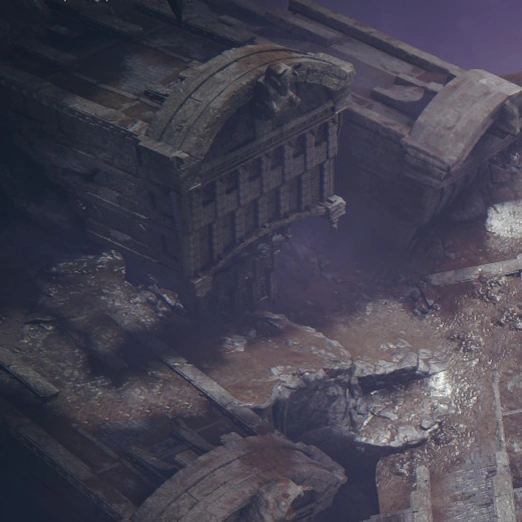
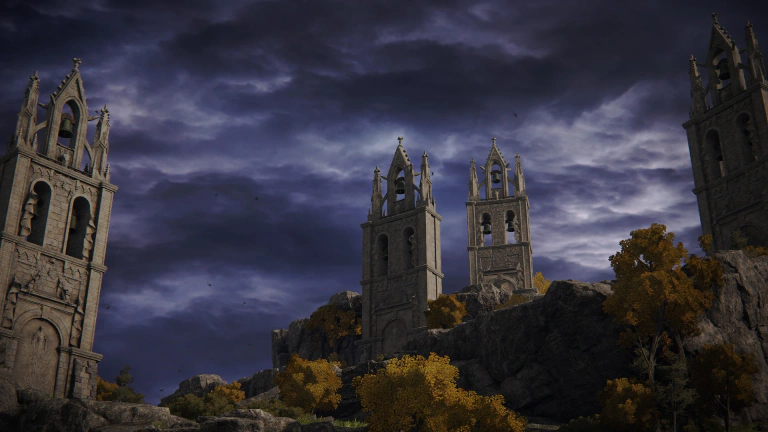
The old statues portray a bald-headed elder with a long beard and a missing right eye, dressed in a hooded robe and holding a stone tablet to his chest with elongated arms, though individual examples vary. Those on stone-coffin ships show him in his most human form, flanked by maiden-and-lord pairings, and may be among the earliest. Works attributed to the Ancient Dynasty give him a damaged right eye and arboreal traits—most notably a root-like beard—and depict him embracing one half of a broken tablet with tightly crossed arms, the discarded half placed at his feet; the held fragment bears a tree, while the other contains a ringed world map or sun. Statues at the Cocoon of the Empyrean omit the rejected tablet and replace his legs with roots. The figures at The Four Belfries, likely the most recent, emphasize his emergence from dense roots or dead branches. His robes have extended sleeves, and he raises his hands to his chest. His legs and both tablets are absent.

Background
A bearded man was revered in the Ancient Dynasty that existed long before the age of the Erdtree. His heroic followers were sent off with Great Grave Glovewort in great stone coffin ships for burial at sea, drifting towards the Lands Between. When the massive arks finally washed up on the Cerulean Coast, their contents had putrified into a viscous sludge of bruise-colored putrescence. Though tainted and impure, the Deathbirds nonetheless cleansed the putrid remains in their ghostflame kilns, until they one day stopped.

His followers established a series of palaces along the Siofra and Ainsel Rivers, where claymen priests used crude weapons made from shards of fallen meteorites, which also arrived from outside the realm. They constructed the Hallowhorn Grounds, Uhl Palace Ruins, Uld Palace Ruins, Lake of Rot, Grand Cloister, and Mohgwyn Palace, and later The Four Belfries. At some point, their ancient dynasty collapsed, and the tablet-clutching god's name was forgotten.
The Ancestral Followers later worshipped Ancestor Spirits among the dynastic ruins. Their ritual implements evoked the power of horns, trees, and Deathbirds. The followers' faith existed beyond the influence of the Erdtree, asserting that new life arises from death, and from Death, one gains power.
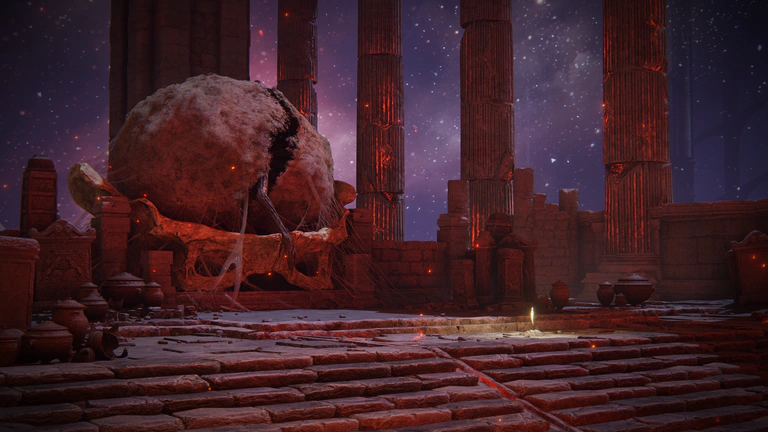
After the outer god of Rot was sealed away in the Grand Cloister, the Kindred of Rot prayed toward scarlet rot-infested statues of the bearded man.
The Mohgwyn Dynasty worshipped a large statue of the bearded man at the Mohgwyn Dynasty Mausoleum, which faced the Cocoon of the Empyrean, where eight smoldering statues of the bearded man portray him without legs, rising upward.
Followers
Locations
Mausoleum Complex
Siofra River Well Depths
The Fifth Belfry, found just north of Castle Ensis
Underground Ruins
Uhl Palace Ruins (north)
Uhl Palace Ruins (south)
Sources
Adapted from the original article, under CC BY-SA 3.0.